
Case presentation
A 23-year-old man with left-sided Poland sequence presenting with:
- Hypoplasia of the serratus anterior muscle
- Hypoplasia of the pectoralis major muscle, present only at its insertions on the clavicle and first costosternal junction
- Absence of the pectoralis minor muscle
- Absence of the nipple-areola complex
- Mild shortening of the ipsilateral upper limb
The patient also presents a deep chest depression consistent with grade 3 pectus excavatum associated with dextrocardia.
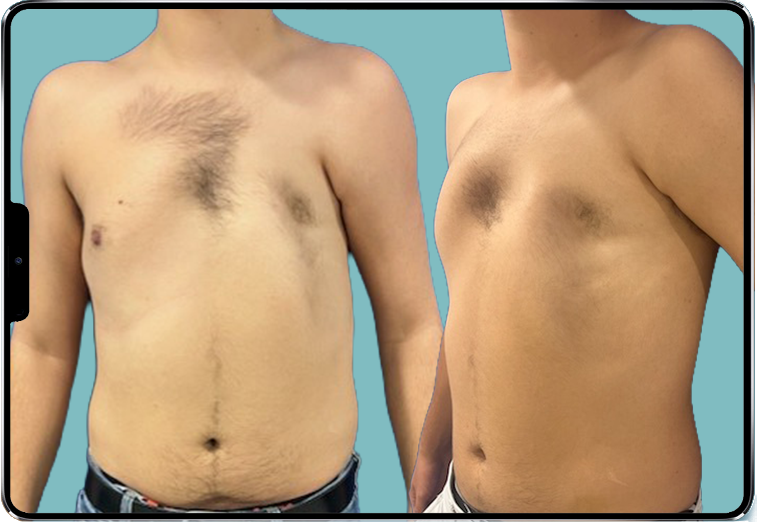
The deformity corresponds to a hybrid type 4M Poland sequence with associated pectus arcuatum, which poses specific challenges in surgical planning.
Surgery with a custom-made 3D implant
It was decided to perform the reconstruction using:
- A custom-made silicone elastomer implant
- Three-dimensional CAD-3D modelling
- Implantation following the technique described by Chavoin
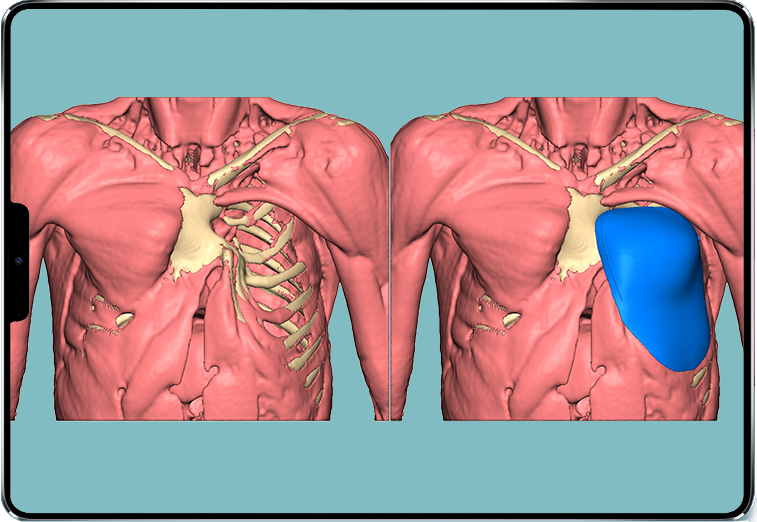
This approach allows the implant to be adapted to the patient's anatomy, optimising the restoration of the chest contour.
Surgical procedure
During surgical dissection, the following were identified:
- Pulsatile tissue adjacent to the sternum
- Brachial plexus close to the dissection plane
The implant was placed without structural injury.
Postoperative course
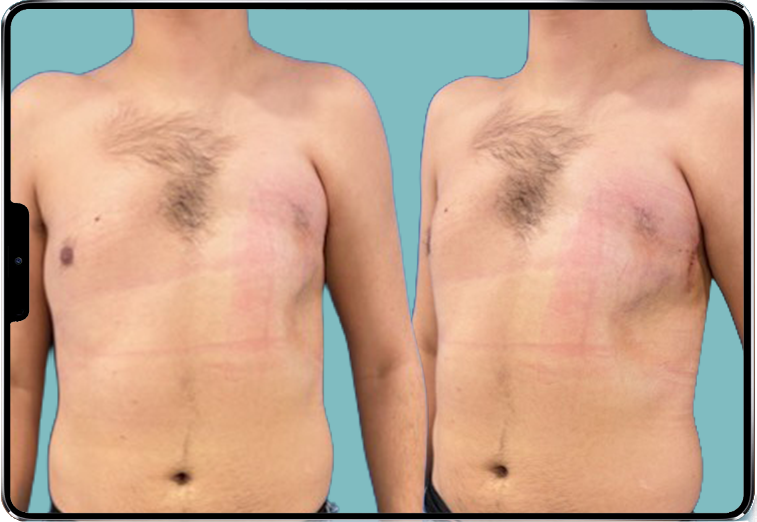
Three days after surgery, the patient developed a haematoma, which was resolved through serial drainage with a cannula.
The subsequent course was favourable, with no aesthetic or functional sequelae.
The final aesthetic result was satisfactory, with a high degree of patient satisfaction.
Postoperative radiological assessment
Following the procedure, CT segmentation was performed, showing:
- Absence of rib agenesis
- Absence of direct contact with the heart
The hypothesis is that the pulsatile tissue observed intraoperatively corresponded to serratus anterior muscle supplied by a large-calibre vascular pedicle.
Conclusions
In the surgery of complex congenital malformations, it is essential to consider the associated anatomical variations.
Preoperative planning using CT and CAD-3D design makes it possible to:
- optimise chest reconstruction
- anticipate anatomical particularities
- minimise intraoperative risks
In complex cases of pectus arcuatum associated with Poland sequence, reconstruction with custom-made implants represents a safe and technically simpler option than procedures such as Nuss or Ravitch.
Authors
Lead author
Dr Teresa Nuñez-Villaveiran is a plastic, reconstructive and aesthetic surgeon trained in Spain with international specialisation. She graduated in Medicine from the University of Navarra and completed her training in Paediatrics at Hospital La Paz in Madrid before undertaking an internship in general surgery at the University of Illinois Metropolitan Group Hospitals in Chicago. She subsequently specialised in Plastic and Reconstructive Surgery at Hospital La Paz and completed a fellowship in craniofacial surgery at Cleveland Clinic and Akron Children’s Hospital (USA).
She holds a Doctorate in Medicine with international distinction and a «cum laude» qualification and is certified by the European Board of Plastic Aesthetic and Reconstructive Surgery (EBOPRAS), where she also serves as Secretary General and examiner. She is the author of numerous scientific publications and an associate editor of Plastic and Reconstructive Surgery (PRS), as well as a reviewer for several of the most influential international journals in the specialty.
In her clinical practice, Dr Nuñez-Villaveiran adopts a personalised approach combining advanced reconstructive surgery and modern surgical planning to provide solutions tailored to each patient.
Collaborators
This clinical case was carried out with the collaboration of:
- Dr Noemí González-Muñoz, Consultant Plastic and Reconstructive Surgeon, Hospital General de Granollers, Spain
- Prof. Jean-Pierre Chavoin, former Head of the Plastic Surgery Department at Toulouse University Hospital, France