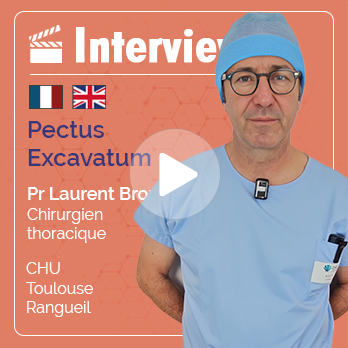
Hello, my name is Laurent Brouchet, and I am a thoracic surgeon at Toulouse University Hospital. My practice is mainly focused on oncology, but I have also been performing Pectus surgery for around ten years. Little by little, I have diversified my practice, mainly in response to patients' requests.
What is your experience with the 3D implant technique?
My experience with the 3D implant technique is primarily that it provides excellent cosmetic results. We must not lose sight of the fact that this remains the number one concern for these patients, who are often young and very self-conscious about their condition.
The cosmetic result (of the custom-made 3D implant technique) is clearly of much better quality, particularly in sometimes complex and highly asymmetrical deformities, compared with the Ravitch technique.
Does Pectus cause functional problems?
I tend to take the view that it generally does not. When we assess patients with Pectus, we usually do not detect any particular cardiorespiratory disorders. There may be a difficult psychological experience expressed through cardiorespiratory symptoms, but this is often a way for children to feel able to ask their parents to take them for a consultation. It is often a psychological defence mechanism that manifests itself as pain or shortness of breath.
Cardiac compression has been described in the scientific literature. It is relatively rare and, throughout my career, I have seen one case.
True cardiac compression is generally rare and is investigated by the cardiology department at Toulouse University Hospital using MRI, but it remains an exceptional occurrence.
What are the advantages of implants compared with orthopaedic techniques?
The advantages of 3D implants compared with orthopaedic techniques include the simplicity of their placement. It is a relatively quick procedure, is not particularly complicated to perform and does not alter the rib cage. If, for one reason or another, the patient wishes to have the implant removed, their rib cage remains completely intact.
Another advantage is that, in highly asymmetrical cases, the Ravitch or Nuss techniques do not provide a satisfactory correction, so to speak, and the cosmetic result obtained with custom-made 3D implants is far superior.
Postoperative recovery is extremely straightforward. In terms of pain management, patients who come from far away generally stay one night before the procedure and one night afterwards, and are discharged the day after surgery. They generally only require class 1 and 2 analgesics during the first 48 hours, followed by class 1 analgesics after one week. Morphine is hardly ever required.
Could you give us an example of a case treated with this technique?
This was a patient with a relatively asymmetrical, deep and very unsightly funnel chest. It mainly affected him psychologically, as he had no particular functional complaints. The procedure was quick, taking just over an hour, and everything went relatively well.