I am a reconstructive plastic surgeon in Brest and have been working in private practice for almost two years. Prior to that, I worked for several years in a hospital setting, where I was able to gain experience with 3D implants for approximately five years. These implants have been primarily used in Pectus Excavatum surgery, but I have also treated patients with Poland syndrome as well as calf atrophy.
Could you give an example of an indication treated with custom 3D implants?
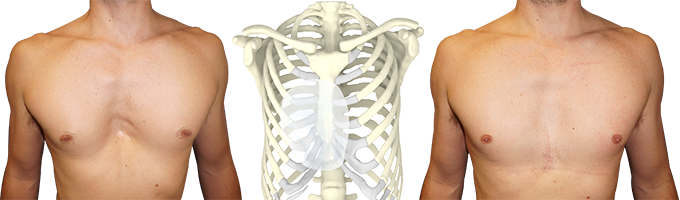
One specific case of Pectus surgery involved a young woman who played handball at a very high level, competing in the pre-national league. She consulted me for a funnel chest deformity that caused her significant discomfort. This case represented a real challenge, as she was a high-level athlete.
Since the Pectus implant is placed beneath the pectoral muscles, it was essential to correct the deformity with extreme precision to ensure she was satisfied with the aesthetic result while avoiding any functional impairment.
This was successfully achieved, as we were able to implant a device perfectly adapted to her anatomy. She resumed physical activity at exactly the same level as before — namely advanced competitive sport — without any functional discomfort related to the scar or the use of her upper limbs.
Could you give an example of an indication involving the calves?
A patient who consulted me for calf surgery presented with unilateral calf atrophy secondary to a congenital neurological abnormality. What motivated her to undergo surgery was the fact that she was getting married and wished to wear a short dress. The challenge was to deliver, within the available timeframe, a precise and perfect result with good symmetry before her wedding. She was delighted with the outcome, which was a great professional satisfaction for me.
What is your overall assessment of the implant technique?
Surgery based on computer-aided design (CAD/CAO) is generally what allows surgeons to create fully customized 3D implants. This approach is highly valuable, as it ensures ultra-precise anatomical correction and guarantees an optimal outcome for the patient.
I find it extremely satisfying to know that we are not only correcting the anatomy as accurately as possible, but also providing a durable and precise solution that will never require revisions or implant replacement.
It is a truly rewarding approach, and over the years I have observed a high level of patient satisfaction following the placement of these implants.