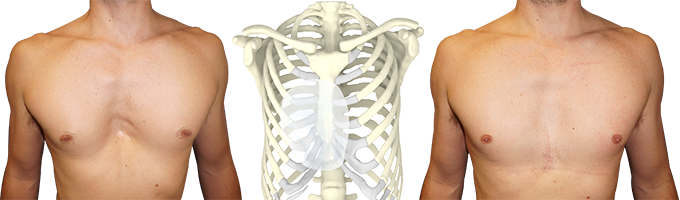
Key takeaways
- Pectus excavatum is generally not a life-threatening condition and requires individual medical assessment.
- Custom-made 3D implants allow for shorter surgery, less pain, and often faster recovery.
- Hospital stays are usually shorter, with a gradual return to work and sports activities.
I am Dr Benjamin Chevalier, a hospital-based physician in the department of thoracic, cervical and lung transplant surgery at Bordeaux University Hospital, Haut-Lévêque site in Pessac. I have been working in this department for about ten years and have specialized, among other things, in chest wall surgery and congenital deformities such as pectus excavatum, Poland syndrome and others. I currently treat between 25 and 30 cases of pectus excavatum per year, with two or three associated Poland syndromes.
Until three or four years ago, I mainly performed modified Ravitch-type osteochondroplasties and some Nuss procedures for younger patients. Over the past few years, requests and indications for custom-made filling implants have increased significantly, as most demands are primarily aesthetic. Today, 90 to 95% of my cases involve this alternative technique.
What is your feedback on the 3D implant technique?
The feedback has been excellent, which is why I use implants so frequently. From a surgical standpoint, procedures are shorter, less risky, hospital stays are reduced, and both post-operative and long-term pain are significantly lower.
This technique allows for a much faster return to professional and physical activities. Patients report very rapid recovery, and above all, excellent aesthetic results, which is usually the primary reason for consultation.
Is pectus excavatum dangerous?
Pectus excavatum represents absolutely no danger; there is no life-threatening risk. In rare cases, there may be cardio-respiratory consequences, but this is very uncommon.
The main impact, so to speak, concerns patients’ quality of life, particularly from an aesthetic and psychological standpoint.
Could you describe the surgery using 3D implants for pectus excavatum?
A vertical incision of approximately 7 to 8 cm is made in the center of the chest, directly over the deformity. The pectoral muscles are detached from the ribs and sternum. The aponeurosis (the white connective membrane) of the rectus abdominis muscles is slightly opened on either side of the linea alba, the central midline of the abdominal wall.
The implant is then positioned within the deformity, in direct contact with the rib cage, anchored inferiorly within the abdominal muscles and covered by the pectoral muscles. These muscles are no longer attached to the sternum and ribs but are sutured together over the prosthesis.
Can you explain the post-operative recovery?
Post-operatively, I keep my patients hospitalized for 48 hours, mainly to monitor for the absence of hematoma and to perform an initial punction. Fluid collections inevitably develop around the implant in 100% of cases; these are called seromas and must be aspirated weekly until the body stops producing this fluid, usually after three or four sessions.
Patients must wear a compression vest day and night for one month to limit seroma formation.
Return to professional activity depends on the patient’s job. The goal is to avoid excessive strain on the pectoral muscles initially, as they are no longer attached to the sternum and ribs but only sutured together. Before resuming intensive use, proper healing is essential. Sick leave generally ranges from two weeks to one month, depending on the profession.
For returning to physical activity, patients must wait 2 to 3 months for sports that do not heavily involve the pectoral muscles, such as running or cycling. However, for bodybuilding, climbing, or sports that place significant strain on the upper body, a six-month break is required.